Friday, April 18, 2025

Sniffer goes to war

 When we last saw Sniffer and the Deadly Dozen, they'd reunited and joined the army, with the USA now at war with Japan and Germany. So now let's take a look at what those twelve notorious murderers got up to in battle!

There aren't as many war stories as you might think. Starting with this issue, Daredevil #12, Lev Gleason's Comic House comics went bi-monthly. Wartime paper shortages and rationing are presumably to blame, though it seems to have hit them more quickly than other comic publishers. This one came out two months after #11, and that's the interval between issues going forwards, at least for a while.

Sniffer is once again promoted very strongly on the cover, as "America's sensational comic find of the year" - they're still keen to stress that he's hugely popular with readers, and they've had time to get actual feedback on him now, so I assume a lot of kids really had jumped aboard the bandwagon and become Sniffer fans! He certainly holds on to his spot in "Daredevil", even when paper rationing really kicks in and despite various tone-changes in the comics...

Daredevil's double-length story (16 of the 64 internal pages of the comic) has him fighting a murderous circus strongman, with brief prologue and epilogue reminding us DD is in the army now bracketed around what's presumably a story written pre-war. There are a couple of very gruesome deaths in this one! But further into the comic we can find some real wartime adventures for our hero Sniffer!


We last saw the Deadly Dozen in the army, but we start this next adventure with the announcement that they've been transferred to the marines. But we do start with a nice splash-panel lineup of our heroes! The story itself, though, is like all the wartime adventures not the high point of Sniffer's career. He's a character suited to loveable scams and comical low-level borderline-criminal activity (his original introduction as a killer was very quickly ditched). Adapting him and his eleven sidekicks to war-themed stories always feels very awkward. Carl Hubbell is still the artist; writers of these stories are a matter of conjecture.

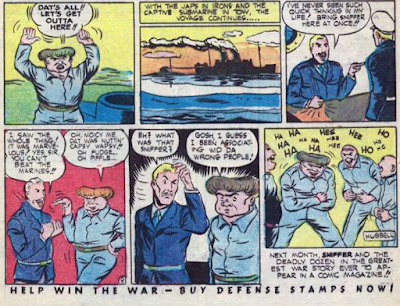
It starts with the general, feeling that Sniffer is too rough and needs to be brought into contact with breeding and culture, introducing his nephew to our hero. The nephew is camp and limp-wristed, and his speech bubbles are decorated with musical notes. He doesn't really fit in with the Deadly Dozen. They take him to the toughest bar in town the night before shipping out, and it looks like we're going to get a hilarious culture-clash storyline, but then the nephew just disappears a page later, and the rest of the story involves Sniffer first finding Japanese spies at the docks, then capturing the crew of a Japanese submarine. Satan, Egghead, Giant Killer and Owl each show up for a panel or two, but as is usual for these guys, they don't really do anything. And then the end of the final page harks back to the opening of the story, which the reader has probably forgotten all about...
Also in this issue of Daredevil - two pages of letters from children who had been evacuated from London to Moulton, Lincolnshire, England. Just next to Spalding and practically next door to my old stamping ground of Boston. They weren't fans of Daredevil, but "a very nice lady" in New York had sent her brother, who lived in England and was in charge of the school, five dollars to organise a party for them. The Daredevil comic printed the address of the school and urged readers to send money of their own over there. Letters pages became a regular feature of Daredevil (with letters from actual readers in America) long before they were normal in American comics.


The next issue is a big one for Daredevil, though even he might not have realised what has begun here...

Yes, as announced on the cover, it's the first appearance of the Little Wise Guys! And, with Daredevil nowhere to be seen, this story sets about introducing them at length. Fat kid Meatball runs away from the orphanage when an overly motherly woman tries to adopt him. Lanky idiot Scarecrow runs away from his boss after being swindled out of money. Little kid Pee-Wee is being shaken down for protection money when rich kid Jock comes by and beats up the bigger bully effortlessly. Pee-Wee tags along back to Jock's house, where they find Meatball and Scarecrow hiding in the barn, and a gang is formed! Later, the new friends are being chased by a bull when a boomerang saves them - it's Daredevil, making his first appearance on page 10, and making friends with the kids! Then they have a somewhat incoherent adventure about Nazi infiltrator doctors killing innocent Americans, coupled with a moral that lynch mobbing of suspected murderers is sometimes a bad thing. But the point is, the Daredevil comic has made a radical change of style with this issue - although the solicitation of reader feedback about the Little Wise Guys is rather more even-handed than the one that got Sniffer his own series. Although with a special prize for the best "is Daredevil better or worse with the LWGs?" letter, most readers probably hedged their bets by writing in and saying they loved the new characters!

Sniffer, meanwhile, is right at the end of the comic this month, but still continuing his tour of the armed forces!

With a shared credit between Hubbell and Dick Wood, presumably the writer, it's an all-action adventure for our heroes! Although they start out still in the marines, the Deadly Dozen are soon in trouble for fighting with their new athletic coach, and transferred to the commandos. On the way there, a rich lady is shocked by Skully's appearance (and no wonder, because he's drawn rather more skully than usual here), but charmed by Lady Killer, who chats her up for the sake of her $20,000.

And when they arrive at the camp, Sniffer finds out about a Japanese battleship in the area and wants to take out a little boat to capture it. The commander won't hear of it - boats cost twenty grand - so the Dozen just steal one, knowing they can pay it off with Miss Tiddle's money. They sink the battleship, of course, with some comical banter along the way!


The cover of our next issue of Daredevil shows the range of different strips to be found inside:

The 'special' Daredevil story has him and the Little Wise Guys stumble upon and thwart a German plan to capture Rudolf Hess, who's apparently being held somewhere around the Canadian border - it's not really all that special, but these comics really are a fun read. Sniffer, meanwhile, is still battling the Japanese - the various stories in Daredevil are split pretty evenly between Germany and Japan.

This is rather a fun one - Sniffer picks a fight with new recruit "Fatso", who proves to be an even more impressive brawler than Sniffer himself! The two of them end up taking out a large part of the Japanese army, and Sniffer comes out on top in his own unique style...

Meanwhile, there have been thousands upon thousands of implausibly quick responses to last issue's question about the Little Wise Guys, and it's all very much like how Sniffer and the Deadly Dozen got started!


And the next issue of Daredevil is a shocking one!

The chance to win a boomerang just like Daredevil's must have lured in a few readers, and the inside front cover tries to encourage them to read the other two titles in Lev Gleason's line, too!

Iron Jaw, arch-foe of Crimebuster over in Boy Comics, will eventually turn out to be an important figure in Sniffer's ongoing saga. The advertised comic, Boy Comics #8, promises on the cover in big letters that "IRON JAW DIES in this issue!" but reports of his death eventually turn out to be exaggerated. At this point he's entirely unconnected, but just remember that name for future installments!

Meanwhile, Daredevil's story has an unexpected twist, to say the least. For one thing, it's barely a Daredevil story at all - the focus is entirely on the Little Wise Guys. They're playing a game of American football against another kid gang, the Steamrollers, to raise money for the USO. The Steamrollers cheat to win the game, and also pocket the money for themselves, and they're also stealing tyres from cars under the leadership of their young adult boss, Tyglon. The leader of the Steamroller kids is a skinhead called Curly. The Little Wise Guys declare war on the Steamrollers... and they're not kidding when they say 'war'. The two sides set a date and lay down the rules - no guns, knives or razors, but anything else goes. And they meet in gritty and very deadly serious violence on the battlefield. Curly pretends to join the Little Wise Guys but is secretly still working for the Steamrollers. Pee-Wee saves Meatball from a violent beating, so when Pee-Wee is captured by the enemy, Meatball feels he has to be the one to save him (knocking out Scarecrow to get his way). Meatball hides in a freezing pond in the course of rescuing his friend, they escape through the snow, but Meatball is feeling ill, and subsequently dies of double pneumonia.

That's right, Meatball dies. This starts out like the adventures of a kid gang, and Meatball actually does die! It's a downright weird thing to put in a kids' comic! The Steamrollers, moved by his death, surrender and renounce their criminal ways. Tyglon is taken to prison, Curly has a change of heart and sides with the Little Wise Guys, and Daredevil shows up at the end to deliver a moving eulogy, played deadly seriously and talking about Meatball as if he's a hero who's died in the real war which is still of course raging in the real world. It must have struck a real chord with readers who would at least remotely have heard about people dying in the conflict. Reading it in 2025, it's a bewildering thing to see...

Then there's the competition to win Daredevil's boomerang - all you have to do is choose which character you want to see promoted to their own 64-page comic!
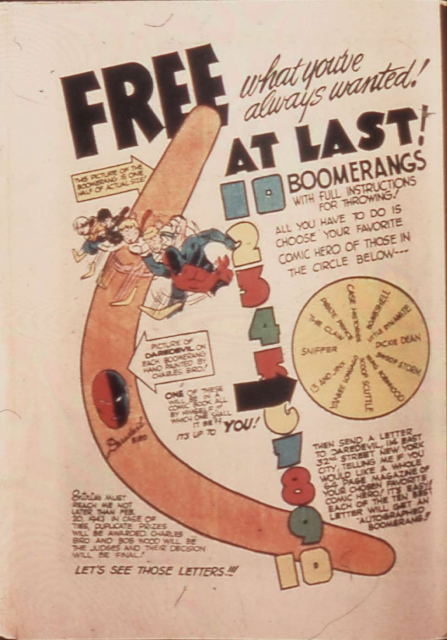
Sniffer's name seems to be positioned so that it's the first one to catch the reader's eye (along with Dickie Dean, at least). They still seem to be going out of their way to generate demand for the King of Smell! Maybe he really was popular with the readers, but sadly there was no 64-page comic for any of these guys. Paper rationing is kicking in as we move into 1943, and all across America the comics are being cut down to 56 pages, they're coming out less frequently, and launching new titles becomes much less possible.

Sniffer will have to be content with playing second fiddle to Daredevil. And his latest adventure can't compete with the Daredevil story that precedes it!

The Deadly Dozen get lost on their way to a commando raid, and come across what the dialogue calls tigers but the artist draws as lions. They belong to a circus that had been stranded in China when war broke out, and when Japanese soldiers land on the island, the Deadly Dozen beat them by pretending to be circus performers. It's a story that's trying to be funny, but falling flat more often than not. It's strange to see a deadly serious war in a kid-gang story followed by a cartoon-style romp from the grown-ups...


Moving into 1943 with Daredevil, the war is passing quickly...

The inside front cover is taken up with a message from Lev Gleason, apologising for being busy with his air force training, but assuring readers that Comic House is safe in the hands of Charles Biro and Bob Wood. Most publishers were shadowy, anonymous figures to the readers, but Lev Gleason maintained the kind of personal connection that Stan Lee would have huge success with in the sixties at Marvel.


The Little Wise Guys are missing Meatball, set out to raise money to buy him a tombstone and end up thwarting a counterfeiting ring based at a reform school (most of whose inmates end up dying in the course of the story, poisoned by the evil boss). Curly shows his worth and is accepted as a member of the gang. Daredevil is more actively involved in this one, but still feels like a guest star in his own series. He'll continue to fight, and ultimately lose, a battle for primacy in the comic for the next few years.

As for Sniffer, he's up to his usual wartime antics...


The Deadly Dozen are "somewhere in the Solomon Islands", tramping through the jungle. They stumble over a Japanese plan to build a warship, naturally, and Sniffer ends up in a fight with a giant sumo wrestler, which he wins by accident. But he's only really motivated by wanting to get with a beautiful Japanese refugee woman, and the rest of the Dozen jeer at him for it. None of the Dozen get names or any kind of personality in this one - having twelve characters in the stories really should provide more potential than this, but we're limited to making fun of the Japanese for the duration of the conflict...


The next cover of Daredevil promises some real wartime action...

The Daredevil story inside isn't anything to do with that scene. Rather than plunging into the valley of death, the Little Wise Guys just have to deal with Jocko's father noticing three boys are living in his barn and telling them to leave. But then he's shot by an assassin, the Wise Guys (who all happen to share his blood type) give life-saving transfusions, and it's all a happy ending. Daredevil tracking down the killer / blackmailer / generally unpleasant man takes up most of the story, and it ends with our hero promising to tell his origin to the Wise Guys next issue!

The stories are fluctuating wildly between childhood larks and deadly warfare. Sniffer has the same problem...

He creatively uses his sniffing powers to get information from a captured Japanese pilot. This, combined with his drinking and insubordination and complete unsuitability for the army, leads him to be transferred to the secret service and shipped off to Australia - without the Deadly Dozen. This gets him out of uniform and back into the kind of environment he works best in! Told to find a saboteur called Croaker, he wanders off, gets into a fight, loses his sense of smell, joins a gang of crooks and seems quite happy to go back to that kind of lifestyle. When his sniffer recovers, he realises he's working for Croaker, and gets into a fight with the whole gang (who are basically just presented as a rival mob). He's saved by the Deadly Dozen, who the army sent after Sniffer when he was believed to have gone AWOL. It's a fun romp for our hero!


Daredevil #18, like all the comics published in the spring of 1943, is less weighty than before. It's been reduced to 56 interior pages instead of 64, due to the strict paper rationing that was affecting all comic publishers.


There's still room for the usual "double length" Daredevil story behind that cheerful cover (check out that Mickey Mouse doll - Disney's lawyers would be after any comic that did that today!), and most but not all of the usual backup strips. There's also an advert for a home weather forecaster, because radio and newspaper forecasts have been stopped for the duration!

Daredevil, meanwhile, is telling his origin story to the Little Wise Guys -  a first taste of what will later become a standard theme for a while, when rather than having adventures himself Daredevil will tell the Wise Guys a story. This one, though, describes how his parents were killed when he was a baby, he was raised by "pygmies" in Australia, and rose by the age of thirteen to become the chief of their tribe, inheriting the red and blue costume that the chief inexplicably wears. Then he tracks down and kills his parents' killer (well, he jumps out of a window and breaks his neck; superheroes killing people was out of fashion by this point), and concludes the story by showing his face to the Wise Guys. It's the first time readers have seen it for a good long while, too - Daredevil in his new role as the LWGs' supporting character has been seen only in costume for months.

Daredevil did have a completely different origin story when he first appeared in Silver Streak Comics, but everyone had apparently forgotten about that one by now. As for our hero Sniffer, he's up to his usual tricks...
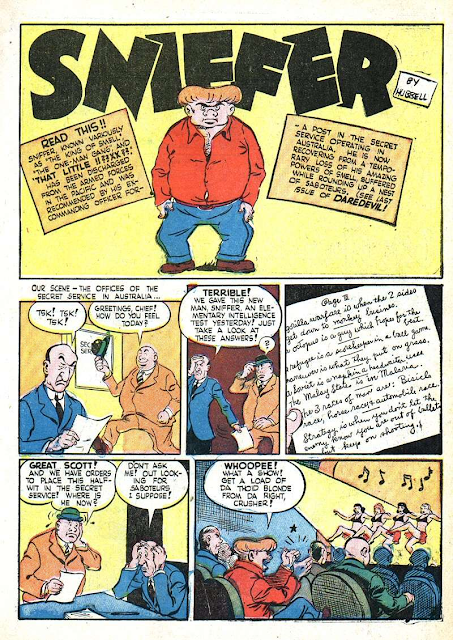
Crusher is starting to become the foremost representative of the Deadly Dozen - he serves as sidekick at the start of this adventure, but then Sniffer goes chasing after pretty girls on his own. One of them is sad because her father has disappeared after being taken to hospital, and foul play might be afoot. Sniffer isn't interested in helping out, but then he accidentally falls down a manhole, ends up in hospital and exposes the doctors there - they've been drugging patients to make them blab military secrets, then killing them and selling the information to the Nazis. Between this and the recent Daredevil story the readers of this comic are repeatedly being told never to trust doctors! Sniffer resolves the whole situation, turns the evil doctors over to his secret service bosses and rescues the girl's father without realising he's doing it!

After the Sniffer story, we get an ad for the other two Comic House titles - Crime Does Not Pay stresses that it's the ONLY magazine of its kind, but in fact it was so popular it soon spawned a huge number of copycat titles from other publishers! It's a little harder to see how Boy Comics is "the original, the one and only", but the superheroes are starting to fade away and crime comics are starting to become the new big thing.


A very atmospheric cover for Daredevil #19, but it's interesting to see how wartime stories are disappearing from the comics. The kids and the US servicemen who were forming an increasing part of the audience perhaps didn't want to read about the heroes beating up the Japanese or Germans...

Readers could be forgiven for wondering who Tonia Saunders is - Daredevil's nominal girlfriend hasn't been seen for a year and a half, shoved aside by the Little Wise Guys. But she's back in this one, and she's getting married to someone else! Daredevil, when he hears about it, is keen to stop her, and enlists the Little Wise Guys' help to try to trick her into falling for him again. Incidentally, despite the more personal nature of this story, DD is once again only ever seen in his full costume. They all stumble into a murder mystery with a cabin full of theatrical actors, Daredevil eventually captures the villain, and Tonia ditches her fiancé in favour of being Daredevil's girl again.

Also in this issue, we announce the lucky readers who've won a boomerang just like Daredevil's!

Sniffer got the most votes, the text announces as a matter of academic interest. There's no mention of the most popular character getting his own 64-page comic, or even a 56-page one. If not for paper rationing, would we have got a Sniffer title, and would it have been a big hit? I guess we'll never know. In the pages that follow, he's still fighting the war in his own way - but, interestingly, his stories are extended to ten pages long from this issue onwards, having varied from six to eight up to this point.

Despite the splash page, this is another rather more domestic story. The chief of the secret service needs a babysitter for his annoying little son Lindsay, and picks on Sniffer for the job. The king of smell has been out shopping, with Giant Killer this time, on his day off, but can't get out of a two-week assignment looking after the brat - mainly because Lindsay has Sniffer's photo in his famous-gangster collection, and threatens to tell his dad about his villainous past unless he does what he's told. Sniffer decides to leave town, but Lindsay follows him. They run into a group of Japanese soldiers in the woods, but when they're surrounded by wild animals, the Japanese spend all night lighting fires to keep them away and tire themselves out. Sniffer, who could smell that it was just kangaroos rather than lions and tigers, is able to capture the whole gang and give Lindsay a well-deserved spanking for good measure.

And the line at the bottom of the final page is interesting...

I wonder if that originally told us to watch for Sniffer in his own comic? Readers of Daredevil don't need to be told to watch for the comic they're already reading. How far along did the plans to grant Sniffer a title of his own get?


The indicia of Daredevil #20 says the comic is now published nine times a year - Lev Gleason is juggling things around, to try to make the best use of his paper allocation.

The Little Wise Guys see a poster offering a thousand dollars to anyone who can last three rounds in the boxing ring against The Unholy Terror, and run to ask Daredevil to do it. They seem to be motivated purely by wanting the money to buy things for themselves - you'd expect some kind of charitable motive, or helping the war effort, but apparently not - and Daredevil cheerfully agrees to do it. Despite the Terror resorting to the old classic trick of a horseshoe in his glove, DD of course wins, and when the Terror and his managers scarper rather than pay the money, it turns out they're murderers and thieves of petrol ration coupons, and our heroes have to beat them up and teach them a lesson in the traditional way.

Sniffer, though, is looking a little different.

It's now "by Hall" rather than "by Hubbell", and the change is noticeable, especially in this first one. To be fair to Dick Hall, he probably drew this in a hurry, and he does copy Sniffer's likeness well. It's just that the backgrounds are minimal, and the figures all look like stiffly posed dolls, without the sense of movement we got in the Hubbell-drawn stories.

The story is fun, though - assigned by the secret service to track down the distinctive-smelling enemy agent who stole from a post office, Sniffer starts by going there with his tommy gun and asking "Where's the safe, bud?" And after a few more misunderstandings along those lines, our hero successfully captures the "one of Australia's most important officials" who has been selling battle plans to the enemy. It's entertaining, it's just not as well drawn as we're used to...


Daredevil #21 poses an interesting question...

Last issue's Daredevil story ended with him promising to ask a favour of the Little Wise Guys in return for him entering the boxing match, but there's no mention of that here. Next issue's story picks up on this dangling thread, and all three were written by Charles Biro and drawn by Norman Maurer, but maybe they were published out of sequence. Nor does this story depict the Little Wise Guys being blown up by a ton of dynamite - there is an explosion that destroys a train rather than a jeep, but Daredevil and the kids don't come along until afterwards. From the scientist friend who didn't survive the blast, they get the plans to a new mini-submarine, which our heroes build in Jock's dad's boathouse. The Nazi agents try to get their hands on it, of course, but the Little Wise Guys have already stolen it, gone out and sunk a whole fleet of German U-Boats by the time Daredevil has beaten up and captured the spies back home. He thinks the kids deserve a spanking rather than a medal.

Meanwhile, Sniffer's still in Australia:

"R. W. Hall" gives us a fuller signature this time, and there's more dynamic posing and background detail than the previous one. Sniffer is unusually determined to go and sort out the mighty Japanese warrior Kolo, considering him "an insult to Americanism", and goes out to the jungle to find him. He fights Kolo with his bare hands, loses, subsequently goes back again and wins. It has to be said, it's not much of a Sniffer story, although he still has his loveable speech patterns and does give a mention of his powers of sniffing. He's confident he'll get a promotion for his work, as the story ends...

... But in fact, that's the end of Sniffer's war effort. Next issue, the story lurches back to New York, and Sniffer (and the Deadly Dozen) are apparently done with active service. Stay tuned for future installments of the life of the King of Smell!

Sunday, April 06, 2025

Teatime in Excel Country

 Some things are universally understood in Britain, but surprisingly unknown in the rest of the world. I once described Blue Peter to a friend as a teatime TV show, and he replied "Yeah, you're gonna have to translate that into American for me. What time do people drink tea in Britain?"

In the same kind of way, the UK Chapter of the Microsoft Excel World Championship organisation sprang into life at teatime (5pm, but this isn't some kind of official time when tea is taken) on Saturday, with the first of three online events leading up to an in-person final in London in September! The winner of which will get a trip to Las Vegas for the World Championship finals!

Check out the UK website here, and please do sign up for the remaining online competitions if you have any kind of interest in fun and friendly mind-gamey competition! It costs a mere £15, and you've got a good chance of being one of the 32 people who get to the final! And if you do, you get to hang out with me in September, because I was one of the first seven qualifiers to come out of Battle 1!


With 33 UK competitors having entered so far, your odds are pretty good of making the top 32, and I promise you it really is a lot of fun! The challenges here are generally less complex and more beginner-friendly than the ones in the world championship events, you can download a couple of sample cases for free from the website, and non-British people can compete just for the fun of it anyway, which I heartily recommend you do!

It's worth mentioning that I would have won this Battle if I hadn't missed out a decimal point. The puzzles in this challenge were all about London buses, with a lot of extra data to manipulate and use to answer the questions, which I did very nicely for the most part. I only slipped up on bonus question 5, which is a simple calculation...


I cleverly provided the correct percentage to increase the bus fare to £175 rather than £1.75, and failed to notice the blunder. In my defence, I'm from the north, and everyone knows everything is super-expensive in London, so it doesn't seem so implausible to me.

Seriously, sign up and take part! It's a great way to pass the time on a Saturday afternoon while you're drinking your tea, studying your double-decker bus timetables and otherwise excelling in popular British activities!

Sunday, March 23, 2025

I liked it better when people dressed up

Here's another comic story that I really love. And I have to ask - it it just me who finds this six-page tale by "Beto" (Gilbert Hernandez) to be hauntingly beautiful and just plain wonderful in its own unique way?


This comes from the second issue of "Measles", the Hernandez brothers' comic for all ages, in 1999. And there's nothing remotely like this in any of the other stories that filled the pages of Measles, not even in the other adventures of Venus. The sense of emptiness in the wide panels, the silence, the wind blowing Venus's hair, her delighted reactions to the mundane Space Fun exhibits... the whole thing just has an eerie, quiet magnificence about it.

Maybe it is just me. Or me and my brother, anyway, because he showed me it in 1999 and agrees completely. What do you think?

Saturday, March 22, 2025

Thundercats and Mike Nomad


In 1954, William Overgard took over as the artist of the "Steve Roper" newspaper comic strip. Overgard had previously tried and failed to sell his own comic strip about Mike Nomad, a tough former commando who got the job done. Within a couple of years, Mike Nomad had joined forces with Steve Roper and became the foremost character in the comic, which was eventually renamed "Steve Roper and Mike Nomad".

Back in the fifties, William Overgard was sharing an artists' studio in New York with Leonard Starr, another talented artist and writer of comics. And thirty years later, when Leonard Starr got a very cool gig as head writer of the new Thundercats cartoon, William Overgard came on board to contribute some stories. He hadn't changed much in those three decades, it seems. Let's take a quick look at the six Thundercats episodes in the Overgard oeuvre...

Mandora - The Evil Chaser

This first episode spells out what William Overgard's approach to writing Thundercats is going to be. Lion-O and Snarf stumble across a big box dumped in the middle of a field, ignore the warning signs and open it to release three interplanetary criminals. Space police officer Mandora arrives and takes over the show, enlisting Lion-O as a sidekick to recapture the villains. One of them, the thief Quickpick, is a quirky rogue who joins forces with Mandora and Lion-O when they're all captured by Mudhogs. The rest of the Thundercats are completely absent from most of the episode, and just come along at the end for the final battle.

It's really different from what had been seen in Thundercats before (this was the first episode shown after the initial scene-setting nine stories by Leonard Starr and Jules Bass) but has a definite coolness to it that the series hadn't seen before. Mandora, with her no-nonsense attitude, cool space uniform and technology and flying motorbike ("the Electrocharger") is something very different. But it takes a while to get used to the minimal involvement of the Thundercats in what's supposed to be their cartoon...

The Fireballs of Plun-Darr

This is more of a traditional Thundercats story - probably the first one Overgard wrote, but since it followed on from Starr's "The Spaceship Beneath the Sands", Mandora probably ended up being produced first. It features the toy-based characters more prominently, as Tygra is captured by the Mutants and Lion-O has to come to his rescue along with non-toy-based but established supporting character Willa. The rest of the Thundercats are once more only in a cameo at the end.

William Overgard's knowledge of "Spaceship Beneath the Sands", incidentally, is clearly based on just knowing the episode would introduce the two new Mutant vehicles. Otherwise, he was just working from the earliest premise of the series - the Other Mutants appear in this one, having been dropped by the other writers after the pilot episode. S-S-Slithe and his minions are also very evil in this one, far from the usual comical bungling that became the norm!

Mandora and the Pirates

And this one is barely a Thundercats episode at all. It's an adventure for Mandora, tackling the space robot pirate Captain Cracker, who takes over the Grey Prison Planet and releases the evil creatures held there. Quickpick is among them, and joins forces with Mandora, ending the episode by officially becoming her sidekick.

Lion-O also comes along to help, playing a smaller supporting role. All the rest of the Thundercats (ie the toys who this cartoon is supposed to be advertising) make only the briefest of appearances, as usual coming along right at the end to help catch the villains. More than any other Overgard story, this one feels like a tale from a completely different universe, with a Thundercat hastily added into the mix.

Dr Dometone

This one's very similar, although Lion-O is joined here by Wilykat and Wilykit. They help Dr Dometone and his giant robot frog protect the Great Oceanic Plug from space villain Scrape and his giant robot electric eel. All these new characters, robots and settings aren't at all part of the usual Thundercats setup. And as usual, the rest of the team turn up late on to make a token contribution to sorting things out.

Mandora gets mentioned at the end - Lion-O says he's handed Scrape over to her - and I wouldn't be surprised to learn that this was fully written and planned as a Mandora and Quickpick adventure before being modified for Thundercats.

The Thunder-Cutter

This episode is more toy-based than usual. It introduces Hachiman, who seems to have been already created as a toy rather than being one of William Overgard's inventions. And he's teamed with Lion-O and non-toy series regular Nayda, against Mumm-Ra and the Mutants. Throw in the usual cameo of the rest of the Thundercat team at the end of the episode, and you've got more toys in this one than any other Overgard!

It's still a bit strange to have a mediaeval samurai in Thundercats, but it's such a divergence from William Overgard's usual predilection for space robots, I don't think we can blame him for that.

Sword in a Hole

Mumm-Ra hires space mercenary Captain Shiner to throw the Sword of Omens into a black hole, and Lion-O and Panthro have to rescue it. A big part of the episode, though, is devoted to telling us all how very cool Captain Shiner is - and to be fair, he really is awesome. It's just that he's not very "Thundercats".

Captain Shiner did get made into a toy for the third range of action figures, when they were going through the cartoon episodes to find new characters. So did Captain Cracker, but I can't help thinking William Overgard would have preferred to see toys of Mandora and Quickpick.


The most distinctive feature of William Overgard's writing, apart from the minimal role of the Thundercats and the unique rigmarole they recite when rushing to save the day ("Tygra ready, ho! Cheetara ready, ho!" etc) is a love of outer space adventure and a galloping lack of understanding of how outer space is supposed to work. Words like 'galaxy' and 'light year' can mean anything. If your spaceship has inconveniently blown up, you can stand around in space and have a conversation waiting for someone to come and pick you up. Captain Cracker makes Lion-O walk the plank, in space, saying he'll fall a zillion miles. And then there's travel times - the Thundercats always drive from Cats' Lair to Lion-O's location at the end of the episode in a matter of seconds. Even when, as in "The Thunder-Cutter", he's somewhere explicitly several days' walk away.

But though you can laugh at his peculiarities, there's no denying that William Overgard was one of the very best writers of this generally excellent cartoon. His adventures are so much fun to watch that I can (and do) still get a kick out of putting them on again now, 38 years after watching them for the first time. If you've been unlucky enough not to watch Thundercats before (even despite all the times I've told you to watch it), you could do a lot worse than starting with the Overgards!

Wednesday, March 12, 2025

Did you ever see a dozen dunderheads?

 One of my most popular posts on this blog is the one about Combat Kelly and the Deadly Dozen. So let's talk about the gang who they totally stole the name from, and more specifically their leader, Sniffer!

This is just the first part of the long and fascinating history of Sniffer, which encompasses a lot of other characters and genres along the way! Part One - How the gang got together!

Actually, Marvel Comics almost certainly didn't steal the "Deadly Dozen" name from the Deadly Dozen who first appeared in Lev Gleason Comics in 1941; they were stealing the concept from the 1967 Dirty Dozen movie and just picked the most obvious D-word for their version. But Marvel definitely did steal another famous comics D-word from Lev Gleason, and our story starts in the very popular forties comic, "Daredevil"!


The bichromatic boomerang-wielding superhero had first appeared as a backup strip in Silver Streak Comics #6, cover date September 1940 (published in July) and was if not actually "the greatest name in comics" as that cover claims, certainly popular enough to quickly be promoted to his own title, the first issue cover-dated July 1941. In his own comic, Daredevil was written and drawn by Charles Biro, a very big name in comics history, and the comic kept running all the way to 1956, when Lev Gleason went out of business - although by that time superheroes were all but gone and forgotten, and Daredevil had long since disappeared from his own comic, which now starred the Little Wise Guys. Marvel Comics remembered the hero, though, and quite deliberately swiped the now-available name for their own latest hero when he launched in 1964. That Daredevil is still being published in his own comic today.


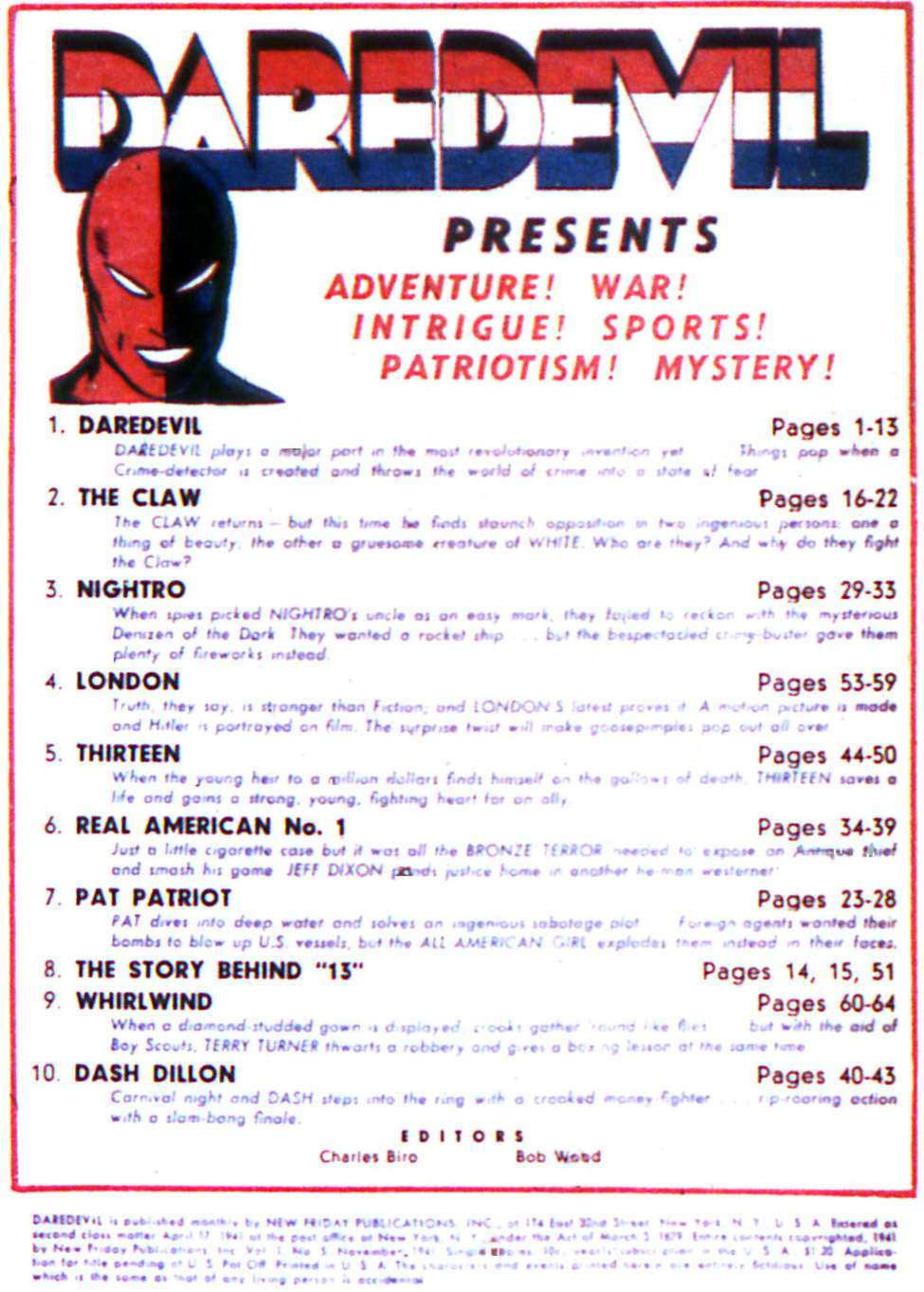
But back in 1941, the fifth issue of "Daredevil" was a standard 64-page comic (not counting the covers) with a host of different features. Adventure! War! Intrigue! Sports! Patriotism! Mystery! The contents page on the inside front cover lists them in a rather strange order, , but the only one we're interested in here is the main event, Daredevil himself. His 13-page story starts with a notice that "The Case of the Mysterious Trunk", advertised last month, won't be appearing until next issue. Instead, we get a story that starts out as a tale about a machine that can predict whether or not a person is capable of murder, and turns into a story about a nationwide convention of criminals getting together to kill Daredevil.

It's not until page 9 that we see they've assembled a team of twelve deadly killers!


The Deadly Dozen - Crusher, Egghead, Snake Eyes, Skully, Benito, Butcher, Giant Killer, Owl, Satan, Sniffer, Turk and Lady Killer all line up for inspection. Sniffer clearly stands out from the crowd, by virtue of being the only one who does anything other than just standing there. He displays his unusual sniffing abilities, and it's immediately obvious that Charles Biro likes him and wants us all to like him too!

Daredevil spends the first half of page 10 beating up the generic crooks, then escapes, with the Deadly Dozen sent out to find and kill him. Daredevil beats them all up, one or two at a time, over the next couple of pages. Not one of them gets any kind of personality beyond a namecheck. Sniffer, still sniffing, is the last of them, and after the whole Dozen have been handed over to the cops, Daredevil speaks to the readers, asking them "Which of the twelve would you like to see me tangle with again?"


This isn't much of a contest. Eleven of the twelve have done nothing, and only Sniffer is at all noticeable in the story we've just read. It really looks like Charles Biro wants to tell Sniffer stories, and wants to get some reader feedback to convince Lev Gleason that that's what the kids want to see. Rigging the results of a popularity contest is very much the kind of thing Sniffer would do in the future, so it's very appropriate.

Sure enough, three months later (Daredevil spent #6 battling a wolfman and #7 finally exploring the much-delayed case of the mysterious trunk), it's the return of Sniffer! By popular request!

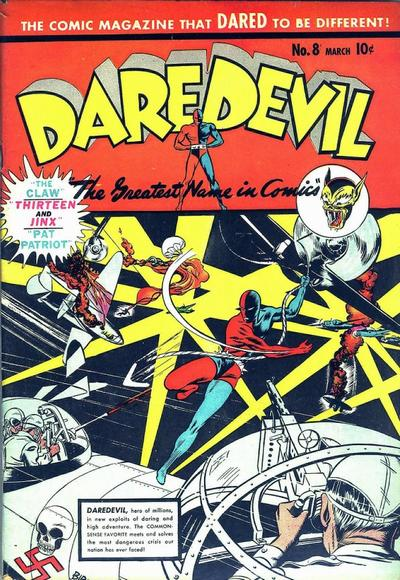
Daredevil #8 was cover-dated March 1942, and went on sale in January. So America is already at war, but this issue was prepared before Pearl Harbor. The battle between Daredevil and the Nazis is just the standard pre-war theme that has been appearing in Lev Gleason comics for years, urging the USA to do something about Germany. The first issue of the comic was actually titled "Daredevil Battles Hitler", complete with photo of der FĂĽhrer's face on the cover.


It's an interesting story. It revolves around an evil insidious German Bund, planning to spread propaganda and ultimately take over the entire USA. And working for them is Sniffer - clearly doing it for the money and resenting being given anything to do that isn't killing people.


But when the evil Herr Herring and his evil Bundists actually give Sniffer the job of killing the young American boy who tried to betray them (I love that he's only resisting the Nazis because he's been to college and been corrupted by free-thinking notions), he contemptuously refuses to do it. Sniffer is a killer, but only of people who deserve killing. And he has nothing to do with the subsequent spread of Lies! Propaganda! Hatred! That's really quite the opposite of what our loveable rogue murderer is all about!


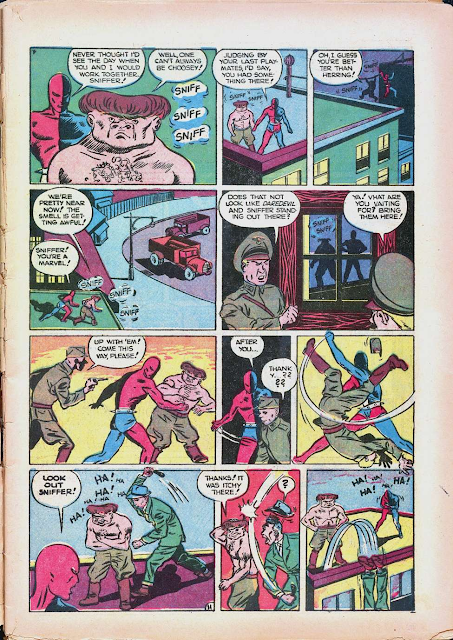
The Nazis confine Sniffer to their dungeon, Daredevil rescues him, and the two join forces to smash the Bund. Sniffer displays some impressive fighting skills along the way!


And our two heroes save the day, and the nation, without any real trouble. Daredevil makes it clear that Sniffer is a great guy, and is more or less going straight, maybe!


It's a strange way to launch a new comedy backup strip, but a later page in the same comic confirms that that's what we're doing here. Sniffer has been granted his own comic strip, starting next month!


And so, as promised, the next month's Daredevil #9 gives Sniffer his own strip, unrelated to the Daredevil adventures, and telling us once again that it's the result of popular demand!


Thousands of letters have poured in after his second appearance, apparently - although this story clearly must have been produced long before the previous story saw print - and it sees Sniffer setting up in business himself, with his Brush 'Em Off Syndicate! Almost certainly written by Charles Biro, but now he's being drawn by Carl "Hub" Hubbell.

He tries to go about it in an unusually honourable way, but ends up killing off a rival mob in the course of his misadventures, showing himself in the process to be an expert hitman. But it's all done in a very light-hearted kind of way, and ends with another panel urging readers to write in and ask for more Sniffer! It seems to have worked, one way or another - Sniffer becomes a fixture in the Daredevil comic from now on.


Daredevil #10, cover dated May 1942, is obviously the first issue produced after Pearl Harbor. Like all the other American comics, it temporarily drops the Germans from its rogues' gallery and focuses on the Japanese. The cover tells us that Daredevil "vows that one hundred Japs will fall for every drop of American blood spilled by their treachery" and his own story in this issue has him join the air force and spill a heck of a lot of Japanese blood.

But the contents page tells us it's Sniffer who's "slated to be America's number one comic character", and he stars in a story clearly written before the war.


Contracted to kill a bookie who absconded with a crook's money, Sniffer sympathises with the bookie when he finds out he's got a wife in hospital and a baby to take care of, and he resolves the issue without killing anyone, even winning a beautiful baby contest along the way (by threatening the judges with his gatling gun). And he talks to the readers again, thanking them for their letters of support!

Sniffer's skin, incidentally, fluctuates from pink to yellow to orange from one page to the next. I'm really not sure what it's supposed to be.

Anyway, in Daredevil #11, the Second World War has caught up to Sniffer at last - business for a hired killer is slack because of the war, so he figures he might as well join the army for something to do. We also get a caption on the first page of his story telling us that "Since he first appeared as a minor character in a Daredevil story," Sniffer has become enormously popular! Charles Biro is still really pushing that 'by popular demand' legend about him!

So Sniffer joins up, and proves an unconventional kind of soldier - he doesn't like the uniform, saying "Even Crimebuster's monkey wouldn't look good in dis!" and picks out a scruffy, ill-fitting outfit for himself instead. More of C.B. and his monkey later; he's the star of Boy Comics, and Sniffer will be meeting him eventually! Sniffer is kept on by the army because of his expert marksmanship, and when assigned to the traditional army potato-peeling, who should be meet but Satan himself!


Yes, it's the return of the Deadly Dozen! Incidentally, "Satan" was a very common name for unexceptional bad guys in American comics of the time. It wasn't until later years that Americans really seemed to associate the name with evil and power.

And so Sniffer and Satan decide to round up the old gang, and get the whole Dozen into the army with them!


I just love that when we see the Dozen going about their everyday lives, Lady Killer is casually killing a lady, and is annoyed when Sniffer interrupts him. And Daredevil takes the final panel to tell us how great this latest development is!

So that's how the gang got together (and split up, and got together again) - from now on the Dozen are a team, although eleven of them will be nothing more than occasionally-seen background characters behind Sniffer. It's a strange setup, made even stranger by being hammered into a war-propaganda context!

And also in this issue of Daredevil, there's an interesting announcement about the future of comic magazines...

Lev Gleason had three titles at this time - Daredevil, Boy Comics and Silver Streak Comics. But now three of the characters from Silver Streak are moving into Daredevil, because Silver Streak Comics is being replaced by an all-new title, Crime Does Not Pay. No superheroes there (the Silver Streak, a very unexceptional kind of hero, was just axed altogether), this new comic was the all-new genre of gritty tales of crime. It took a few years to really become controversial, but crime comics - dwelling gruesomely on the nasty details of crime, with a perfunctory 'crime is bad' moral at the end - upset a lot of people. And it all starts here, but maybe Sniffer and the Deadly Dozen could be seen as paving the way!

Stay tuned for part two of the chronicle - what did Sniffer do in the war?

This is all William Overgard's fault

 I've never done a 'early comics work by writers of the Thundercats cartoon' blog about William Overgard, which is a shocking omission. In my defence, his early comics work consists of:

a) 31 years on the 'Steve Roper' newspaper comic strip, which I have never read but which sounds like it has many wonderful and fascinating similarities to his Thundercats work that I could write about, and

b) A few years drawing comics for Lev Gleason in the fifties, where he's following someone else's script without the opportunity to innovate on his own, and frequently just drawing isolated chapters of a bigger storyline, that would look strange if I just wrote about them alone.

So, obviously, my thought process goes, I need to read the whole history of Steve Roper, right? Individual scans of daily newspapers are available online. And the strip started in 1936 and finished in 2004, so I'd have to read all the pre- and post-Overgard years too, for context...

Maybe I'll have a look at his Lev Gleason credits and see if there's something a bit simpler... ooh, Sniffer and the Deadly Dozen and Iron Jaw...

One long rabbit hole later, there's nothing else for it. I'm going to have to write up the entire history of Sniffer. Most of it's nothing to do with William Overgard at all, so forget the Thundercats angle. I thought I could just do a quick-ish simple summary of the different approaches to the character over the years, but most of it is so good that I can't just skim through it - there's a brief period during the war when it was very dull, but for the most part every single story has funny and interesting things I want to highlight. 

So stay tuned for what will have to be a multi-part catalogue of the saga of Sniffer and the Deadly Dozen and Iron Jaw and Crimebuster and Daredevil. Which might take months or years to write in full. And also an article about William Overgard's episodes of Thundercats, because it really isn't fair to exclude him when he started this whole monstrosity!

Friday, March 07, 2025

The Adventures of T-Shirt

 My life has been plagued by loathsome little girls! Deborahs, Hollys, bleuch!

YouTube randomly recommended me the first episode of the fifth series of T-Bag (or "T. Bag" as I see they traditionally punctuated it, but somehow writing it with a dash feels more natural), and it takes me back. I remember watching that episode, particularly T-Bag's line above, when it first aired in January 1989. I was twelve, and I'd been a fan since at least the second series in 1986 (the one with the numbers), though I'm not sure if I'd seen the first series (with letters) the year before.

1989 was the one with the spoons, and the last one with Elizabeth Estensen as T-Bag. It declined a little after that, but I kept in touch right until the ninth and final series (late 1992 rather than early 1993, to get it shown before Thames TV disappeared). That one really wasn't very good at all.

But the point is, if you haven't heard of T-Bag, it was a British children's TV institution! Each series of ten episodes followed a strict formula - the evil T-Bag was embarking on some kind of nebulous evil scheme, which was thwarted by scattering a group of objects across time and space, and one heroic young girl had to travel around and gather the objects before T-Bag and her assistant T-Shirt could find them. Each episode would feature exactly two guest actors who the girl would interact with and end up retrieving one of the objects, and in the final episode T-Bag would be defeated. It was great.

You were meant to cheer for the girl (Debbie for the first three series, then one with Holly, two with Sally, and I don't remember the rest), but in my usual chauvinistic way I didn't care about them at all. Not even Sally, who turns out to have been played by Kellie Bright, who I subsequently watched in The Upper Hand and Maid Marian and her Merry Men, and plenty of other things too. No, I was always watching it for T-Shirt.

T-Shirt's story arc was the same in each series. Thomas starts out free and happy in the antique shop he apparently inhabits with Debbie, but then is dragged back into T-Bag's service, struggling against it until he's magically mind-controlled to be her willing slave and tea-caddy. Over the course of the series he gradually starts to rebel, and by the final episode he's broken free and joined forces with the girl to vanquish T-Bag once and for all (until next year). He was very cool.

It's possible that I don't like the later years so much because I was growing more mature, but of course T-Shirt was doing the same. Played from start to finish by the wonderful John Hasler, he's around nine years old when they made the first series, and so of course he's around seventeen by the end. Fans of the series got to see him grow up, roughly a year ahead of me, and the way his character and interactions with T-Bag grow and develop while staying true to the consistent feel of the show in general is just brilliant. They should make some more episodes today, it'd be just the same, and I'm sure it'd be a big hit!

Sunday, March 02, 2025

I have no shame

 Did you know there's a website dedicated to Digitser? The 1990s Channel 4 Teletext video game page, famously hosted by The Man With A Long Chin?

Well, there is. And one page on it contains a selection from their letters page, and it's time I confessed something that has been a dark secret for more than thirty years...

I was a regular correspondent to Digitiser in 1993/1994 (as I recall, by the time I went to university in autumn 94, I'd stopped), under the name of The Man With No Shame.

A few earlier letters were under the less imaginative name of Ben Pridmore (which I also used when entering their competitions, some of which I won!), and I also wrote one as "Miriam the Mystic", which got printed too. But it was mainly The Man With No Shame.

I wasn't one of the superstar writers who everyone thought were cool, but I was thrilled to see my pseudonym show up occasionally for the world to see! Once I won a subscription to Gamesmaster magazine by having the star letter on the theme of the week, "What makes you a Digitiser 'super viewer'?"

I can only see one of my letters on that page, and I don't remember writing it at all. But it has to be me, with that name and location...

Most of the letters collected there are from after my time, but for some reason I remember this one (not written by me) and its answer word for word, after all these years...


The "Miriam the Mystic" letter, if I'm remembering the name right, included references to a lot of famous letter-writers, and I slipped my brother "T. Prophet" in there too, which was very nice of me. And they edited that line out when they printed it, obviously recognising that we wrote from the same address. So thanks, Digitiser - do you know how rare it was for me to do something nice for my brother like that? And I never got to show him it...

Sunday, February 16, 2025

Cantabrigian othelloing

 Ah, the Cambridge EGP, biggest and coolest othello tournament of the year. And I scraped the funds together to go to it, and it was a fantastic weekend! 39 competitors, running the full range of old* and new, old* and young, local and international, there was a bit of everything!

*'Old' the first time there means people who've been playing for fifty years, 'old' the second time just means generally geriatric like me. There were beginners and very young people there too, and whatever your level of experience and skill, you'd find another competitor around the same level! It really was a perfect lineup of participants.

I was basically terrible, but ended up with five wins out of eleven, which could have been worse. It's hard to find a way to pretend I achieved my "fifty percent success" target, but I wasn't far off! And it was nice to get away to the familiar surroundings of Trinity College and pretend I'm some kind of varsity type. I've been going to that tournament since I don't remember when. I was definitely there in 2003 (it snowed), but I'd possibly been there at least once before. I'd look it up, but I'm too lazy. I'll research it before I have to tell someone I've forgotten, because that's always embarrassing for a memory master like me...